
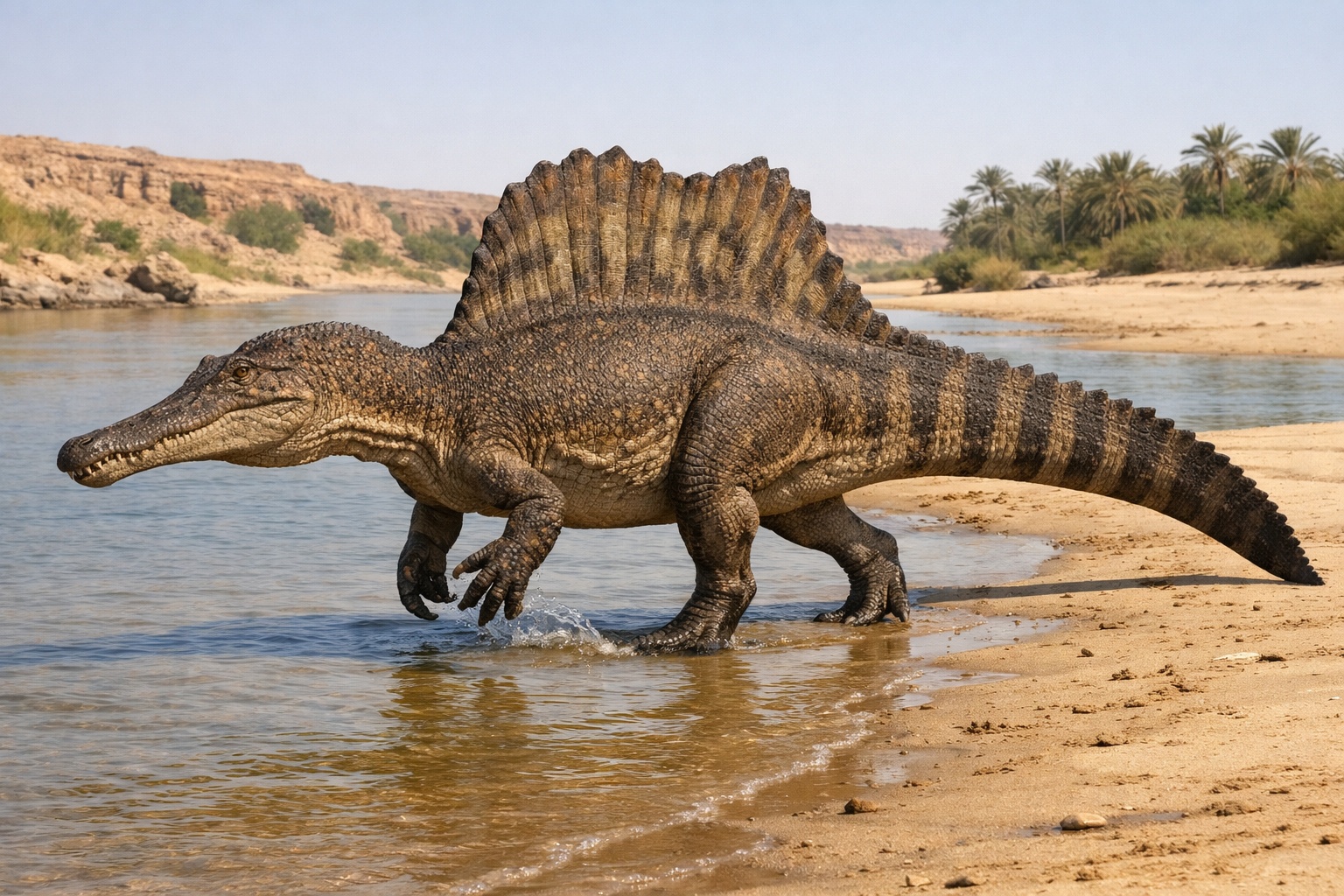
Spinosaurus (Spy-no-SORE-us)
One of the largest predatory dinosaurs ever discovered may have spent significant time in the water — and scientists are still arguing about exactly how it did it.
Spy-no-SORE-us — “SPY-no-SORE-us”
Fast Facts
| When | Around 95–100 million years ago — back when the Sahara was a vast network of rivers and wetlands, long before it ever became a desert |
| Where found | Morocco, Egypt, Algeria, Tunisia — all North Africa |
| Length | Up to roughly 14–15 metres — that’s two school buses end to end, and then some |
| Weight | Estimates range enormously: somewhere between the weight of a large elephant and something far, far heavier. Scientists are still working it out |
| Diet | Meat — mostly fish, possibly more |
| Speed | Terrestrial speed remains uncertain; in water, it showed clear aquatic adaptations, though exactly how efficient a swimmer it was remains debated. |

Fun Facts
It was bigger than T. rex. Possibly by a lot
Length-wise, Spinosaurus is generally considered the longest predatory dinosaur yet discovered — beating out T. rex by several metres. But “largest” gets complicated fast: weight estimates range so widely that comparisons depend heavily on which model you trust. What’s not in doubt is that this was an animal on a scale that’s hard to get your head around.
The original fossils were destroyed in World War II
The first Spinosaurus bones were discovered in Egypt in 1912, shipped to a museum in Munich — and then obliterated in a 1944 Allied bombing raid. Palaeontologists spent decades working from old drawings and photographs. When new fossils began turning up in Morocco in the 2000s and beyond, it was almost like rediscovering the animal from scratch.
Its sail was taller than most adults.
The elongated neural spines along its back could rise over 1.5 metres high. Scientists strongly suspect they supported a sail-like soft tissue structure, though its exact shape remains uncertain. What the sail was for is still debated, with display considered a leading idea, while thermoregulation and other functions have also been proposed.
Its teeth were built for slippery prey.
Unlike T. rex’s bone-crushing, serrated teeth, Spinosaurus had long, straight, conical teeth — more like a crocodile’s. They were well-suited to gripping slippery prey rather than tearing through bone, which fits the challenge of catching animals actively trying to escape underwater.
It shared its world with other giants — but may have occupied a different niche.
Cretaceous North Africa was crowded with enormous predators. Carcharodontosaurus, another massive theropod, lived in the same region. Many researchers think Spinosaurus reduced direct competition by specialising in aquatic prey, effectively occupying a different ecological role in one of the most predator-rich ecosystems known from the fossil record.
Its tail was unlike any other theropod’s
A 2020 discovery revealed that Spinosaurus had a deep, paddle-like tail, with tall spines and elongated bony projections forming a fin-like structure. Nothing comparable is known in other theropod dinosaurs. It remains one of the strongest pieces of evidence that Spinosaurus spent significant time in the water.
It disappeared long before the asteroid impact.
Most dinosaurs were wiped out 66 million years ago, but Spinosaurus disappeared from the fossil record much earlier, around 93–94 million years ago. Why remains uncertain. Environmental changes affecting North Africa’s river systems may have played a role, particularly if Spinosaurus depended heavily on wetland habitats and aquatic prey.
Did You Know — Could It Outswim a Modern Crocodile?
That’s much harder to answer than it sounds. Spinosaurus had genuine aquatic adaptations, including dense bones and a deep, paddle-like tail, but exactly how capable it was in the water remains actively debated. Some studies suggest it may not have matched the swimming efficiency of highly specialised modern semi-aquatic predators like crocodiles, while others support a more capable aquatic lifestyle. A cautious interpretation is that Spinosaurus was highly comfortable in and around water, whether as a powerful swimmer, an ambush hunter, or something between the two. Think less “giant shark dinosaur” and more “very large, very dangerous river specialist.”
Myths & Movie Moments
In Jurassic Park III, it kills a T. rex in the opening minutes.
This scene caused genuine distress among palaeontologists everywhere. Setting aside the scientific nonsense of the two species meeting (they lived millions of years apart on different continents), the fight itself is played for shock value. In reality, Spinosaurus appears to have been heavily adapted for catching aquatic prey, while T. rex was a terrestrial predator of large land animals. They were built for completely different ecological roles — like pitting a heron against a lion and declaring a winner.
People assume it was basically an aquatic T. rex.
The Jurassic Park version of Spinosaurus is a fast, aggressive land predator that happens to be a bit bigger. The real animal appears to have been adapted very differently: long skull, conical teeth, shortened hind limbs, dense bones, and a body plan suggesting substantial association with water. It was likely far less suited to terrestrial pursuit than animals like T. rex.
The quadruped-versus-biped question is still being fought
At various points, palaeontologists have reconstructed Spinosaurus as walking on four legs (like a very large crocodilian), then as a biped, then back toward four legs again. As of the most recent analyses, the debate hasn’t been fully resolved. Any reconstruction you see that presents one posture as obviously correct is getting ahead of the evidence.
Its sail colour is a complete mystery.
Illustrations often show Spinosaurus with vivid red or orange sails for dramatic effect. There’s no fossil evidence for colouration at all. The sail may have been brightly coloured — or dull, or striped, or anything in between. We simply don’t know.
What If It Appeared Today?
Place Spinosaurus in the river systems of Central Africa — the Congo Basin, say, where massive rivers are teeming with fish — and it would very likely find itself in familiar territory. The prey would be different from what it evolved to catch, but it’s reasonable to think that an animal this size, built for aquatic ambush, would probably have no difficulty accessing food. Modern predators — crocodiles, big cats along riverbanks — would very likely give it a wide berth entirely. The most surprising consequence for the local ecosystem would probably be felt by large fish species: Spinosaurus was large enough to target prey that currently has no comparable predator. Whole sections of the food chain would likely shift around it. One important caveat: we don’t know how well its digestive system would cope with modern fish species, so “it would simply eat everything” is an assumption worth holding lightly.
Could You Keep One as a Pet?
💀 You wouldn’t even get to try.
Let’s run the numbers anyway. Spinosaurus needed to live near a large body of water. Not a pond — a river system. It was roughly the length of two school buses and may have weighed as much as several elephants. Feeding it would mean sourcing enormous quantities of large fish, daily, indefinitely. Its teeth weren’t built for anything but gripping slippery prey so that it wouldn’t be coming for you specifically — but getting between a 14-metre apex predator and its river would end one way. The real problem isn’t temperament. It’s that no infrastructure built by humans could house, feed, or safely approach this animal. The logistics collapse before you finish the sentence.
Verdict: 💀
Final Thought
There’s something strange and moving about an animal this extraordinary being known to science for barely a century, blown up in a war, rediscovered almost from scratch, and still not fully understood. Spinosaurus keeps forcing palaeontologists to rethink what a dinosaur could be — not the thunder-lizard of old movies, but something weirder, more aquatic, more ecologically inventive. Whatever it was exactly, it lived in a world so lush and strange that the Sahara it left behind feels like a completely different planet.
More From the Late Cretaceous


Ready for the full scientific deep dive? Read the ExtinctAtlas guide on Spinosaurus →