

Imagine Looking Down Into Dark Water… and Seeing This Rise Up
Not every prehistoric giant walked on land. Some ruled the oceans.
Mosasaurus was a massive marine reptile with jaws full of sharp teeth, a powerful tail, and the kind of presence that would make even modern ocean predators look twice.
MOS-uh-SOR-us — “MOH-suh-SORE-us”
Fast Facts
| Fact | Detail |
|---|---|
| Time Period | 82–66 million years ago — during the final age of dinosaurs, shortly before the asteroid impact that ended the Cretaceous |
| Fossils Found | Europe, North America, South America, and Africa |
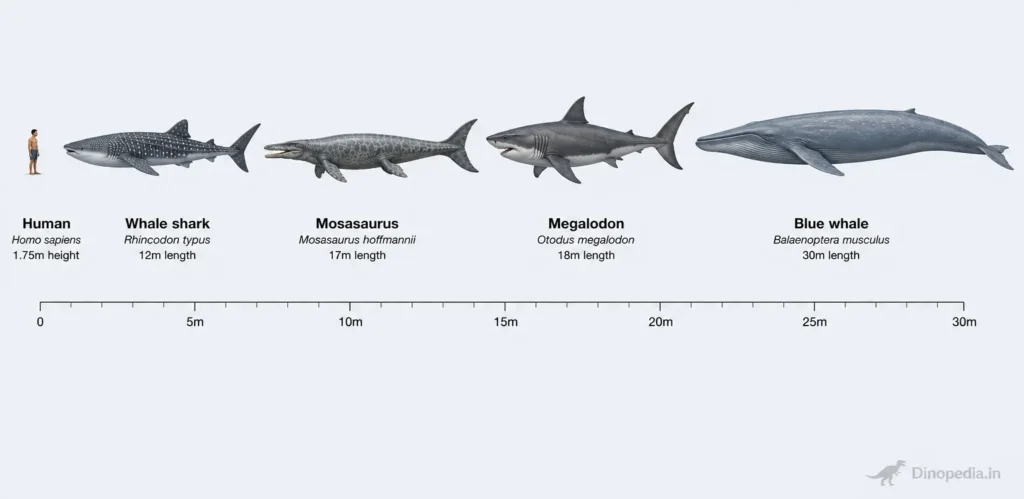
| Length | Largest species reached roughly 15–17 metres (49–56 feet) — about the length of a large city bus or longer |
| Weight | Several tonnes — comparable to multiple large elephants depending on the species |
| Diet | Meat |
| Speed | Likely a fast, efficient ocean cruiser rather than a short-burst sprinter |
Fun Facts
It Was Not a Dinosaur
Despite appearing in dinosaur books, Mosasaurus was actually a giant marine reptile.
It belonged to the squamate reptile group, making it more closely related to modern lizards and snakes than to dinosaurs.
It Had Extra Teeth Inside Its Mouth
Mosasaurus did not rely only on the teeth lining its jaws.
It also had additional teeth on the roof of its mouth called pterygoid teeth, which likely helped grip slippery prey and move it backward during feeding.
Its Tail Was Built for Powerful Swimming
Older illustrations often showed Mosasaurus swimming like an oversized sea snake.
Modern fossil evidence suggests something much more efficient: a streamlined swimmer powered by a strong tail with a prominent lower lobe, more like active fast-swimming marine predators than an eel-like drifter.
It Was a Broad Marine Predator
Fossil evidence suggests Mosasaurus hunted a wide range of prey.
Its menu likely included fish, ammonites, sea turtles, seabirds, and other marine reptiles, depending on habitat and species.
Kansas Used to Be Underwater
That sounds impossible today, but during the Late Cretaceous, a huge inland sea split North America in two.
Marine reptiles, sharks, and strange shelled creatures swam where farms and highways exist now.
It Replaced Other Ocean Giants
Before mosasaurs became dominant, other marine reptiles had already ruled the seas.
By the Late Cretaceous, mosasaurs had become some of the most formidable large marine predators in many ocean ecosystems.
Did You Know — Would a Great White Shark Stand a Chance?
A great white shark is an impressive predator—but against a full-grown Mosasaurus, size would matter.
A large Mosasaurus was significantly bigger than most great whites and heavily armed with powerful jaws and grasping teeth. In an imagined direct encounter, a size advantage would probably favour the mosasaur, though exact outcomes are impossible to know.
Fortunately for sharks, they missed each other by about 66 million years.
Myths & Movie Moments
Jurassic World Supersized It
The Mosasaurus in Jurassic World is unforgettable—but much larger than a real Mosasaurus.
Real Mosasaurus hoffmannii was enormous, but nowhere near the scale shown in blockbuster films.
It Was Not a Giant Crocodile
Long jaws can be misleading.
Mosasaurus was built very differently from crocodiles, with a marine body plan powered by its tail rather than crocodile-style swimming.
We Do Not Know If It Leapt Dramatically From the Water
Movies love spectacular breach attacks.
A large marine predator could certainly surge upward in water, but repeated killer-whale-style hunting displays are not something fossils can directly confirm.
What If It Appeared Today?
If Mosasaurus appeared in the modern Atlantic, it would probably be physically capable of competing with many large marine predators thanks to its size, speed, and powerful jaws.
But modern oceans are very different from Late Cretaceous seas. Ship traffic, fishing gear, pollution, changing water temperatures, unfamiliar prey, and modern diseases could create major challenges.
It is also reasonable to think that younger individuals would face especially difficult survival pressures.
The biggest surprise? Coastal authorities would very likely rewrite marine safety plans in a hurry.
Could You Keep One as a Pet?
💀 You Wouldn’t Even Get to Try
Let’s start with the obvious problem: where exactly would your giant marine reptile live?
A swimming pool is laughably too small. Even a major public aquarium would struggle to house an active predator this large.
Then comes food. Mosasaurus would require enormous quantities of marine prey regularly.
Temperament is uncertain—but “apex marine predator with a mouth full of blades” does not suggest cuddle potential.
Closest modern pet equivalent? Imagine trying to keep a Komodo dragon the size of a bus… in the ocean.
Verdict: absolutely impossible.
Curious about the real science? Read the full Mosasaurus guide on ExtinctAtlas →
Final Thought
Long before ships crossed the oceans, giant reptiles already ruled the seas.
Mosasaurus was not a movie invention or a made-up sea monster.
It was a real predator from a lost world—and that makes Earth’s history far stranger and more amazing than fiction.
More From the Late Cretaceous


Ready for the full scientific deep dive? Read the ExtinctAtlas guide on Mosasaurus →