

It Was So Big, a Farmer Thought Its Bones Were Trees
In 1987, a rancher near Plaza Huincul in Argentina dug up what he assumed was a very large piece of petrified wood. It wasn’t wood. It was a single vertebra — one bone — belonging to an animal so large that its full skeleton, when estimated, stretches the length of a commercial aircraft. That bone eventually led scientists to Argentinosaurus: probably the heaviest land animal that has ever existed on Earth.
AR-gen-TEEN-oh-SOR-us — “AR-gen-TEEN-oh-SOR-us”
Fast Facts
| Time period | Around 94–97 million years ago — the mid-Cretaceous, when South America was an island continent and flowering plants were just beginning to spread across the world |
| Where found | Neuquén Province, Patagonia, Argentina |
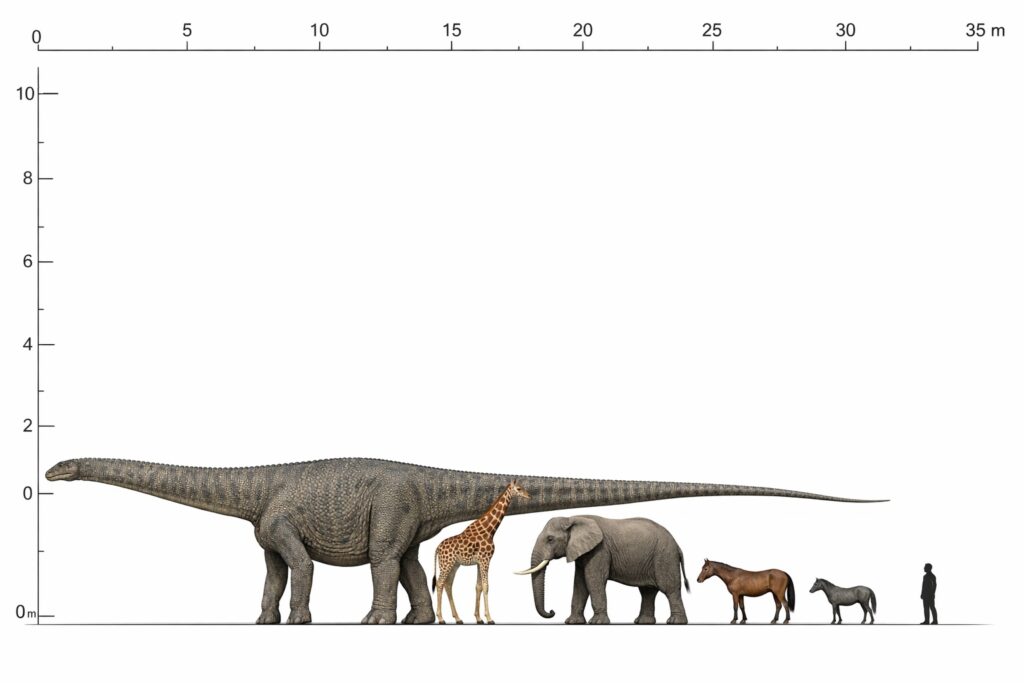
| Length | Estimated 30–40 metres — roughly as long as a Boeing 737 |
| Weight | Estimated 60–100+ tonnes — somewhere between 10 and 15 African elephants, though estimates vary significantly due to limited fossil material |
| Diet | Plants |
| Speed | Very slow — probably around walking pace for a human, consistent with the biomechanics of an animal this massive |
Fun Facts
Almost everything we know comes from a handful of bones
No complete Argentinosaurus skeleton has ever been found. The known fossil material includes a partial set of vertebrae, some rib fragments, a section of the hip, and a shin bone. Size estimates — which range quite widely — are based on comparisons with more complete relatives. What this means in practice is that Argentinosaurus is simultaneously one of the most famous dinosaurs in the world and one of the least understood.
One of its vertebrae was taller than a five-year-old child.
The cross-section of a single dorsal vertebra measures over five feet in height. Each vertebra was internally riddled with air chambers, reducing weight while maintaining structural strength — the same engineering principle used in modern aircraft wings. Without that internal lightning, an animal this size would likely have been crushed under its own skeleton.
It hatched from an egg roughly the size of a large grapefruit.
Despite reaching estimated weights of 60–100 tonnes as an adult, Argentinosaurus probably hatched from an egg only around one litre in volume — about the size of a large grapefruit or small melon. A hatchling was likely no heavier than a small dog. Getting from that to a fully grown adult represented one of the most extreme growth journeys of any animal in the history of life on Earth — an increase in size of roughly five orders of magnitude.
It may have shared its landscape with some of the largest predators ever.
Argentinosaurus’s Patagonian home also contained large carnivores, including Giganotosaurus and Mapusaurus. Multiple Mapusaurus individuals have been found together at a single fossil site, which some researchers think may suggest group behaviour — though whether this represents coordinated group hunting or a coincidental accumulation of carcasses remains debated. Either way, even the largest land predators would very likely have focused on juveniles rather than healthy adults.
Its size was probably its main defence.
Adult Argentinosaurus almost certainly had few natural threats simply due to scale. An adult in good health would have been extraordinarily difficult for any predator to approach, let alone bring down. It’s reasonable to think that the primary vulnerability lies in young animals during the long years between hatching and reaching protective size — a window that may have lasted a decade or more.
It belongs to the same lineage that eventually covered every continent
Argentinosaurus was a titanosaur — part of a sauropod group that became the dominant large herbivores of the Cretaceous. Titanosaur fossils have been found on every continent, including Antarctica. They were the last great dynasty of giant sauropods, and Argentinosaurus represents that lineage at something close to its physical limit.

Did You Know — Is It Actually the Biggest Dinosaur Ever?
Possibly — but it’s genuinely contested. Argentinosaurus has strong claims to being the heaviest land animal of all time, with estimates reaching 70–100 tonnes. But another titanosaur from the same region, Patagotitan mayorum, was formally described in 2017 with a more complete fossil record and has similar size estimates. Because Argentinosaurus is known only from fragmentary material, precise comparisons are difficult. Most paleontologists currently favour Argentinosaurus as among the largest animals ever to walk the Earth — but “the confirmed single heaviest” is a title that the fossil record doesn’t yet allow anyone to award with certainty.
Myths & Movie Moments
It appeared in a Walking with Dinosaurs special — and looked magnificent.
The BBC’s Giants of Patagonia special brought Argentinosaurus to screen in compelling detail, depicting a herd navigating Cretaceous South America while Mapusaurus packs circled looking for opportunity. It’s one of the better prehistoric reconstructions in popular documentary filmmaking. The broad strokes — enormous plant-eaters, large pack-hunting predators, Patagonian landscape — are grounded in the fossil record, even if specific behaviours necessarily involve inference.
People assume its size has been confirmed precisely.
The numbers you see quoted for Argentinosaurus — length, weight, height — vary dramatically depending on the source and the methodology used. Because the known fossils represent only a fraction of one individual, estimates are extrapolated from related titanosaurs. Different methods produce figures ranging from around 60 to well over 100 tonnes. The honest answer to “how big was it exactly?” is that we don’t know with precision. The honest answer to “was it enormous?” is yes, unambiguously.
It’s often assumed that nothing could have threatened it.
Adult Argentinosaurus were very likely beyond the threat range of most predators. But the idea that the species was completely invulnerable ignores the reality of its early life. Hatchlings were tiny. Juveniles spent years reaching protective size. The fossil site containing multiple Mapusaurus individuals suggests these predators may have been drawn to Argentinosaurus in some capacity — most plausibly targeting animals that were young, weakened, or isolated.
What If It Appeared Today?
Argentinosaurus fossils come from Patagonia — a landscape of open steppe, scrubland, and river valleys in southern Argentina. Parts of that landscape still exist today.
A fully grown Argentinosaurus arriving in modern Patagonia would probably find adequate terrain — wide open spaces, river systems, and vegetation. Whether its digestive system could process today’s plant species is genuinely uncertain; the flora of Cretaceous South America was significantly different from the grasses and shrubs of modern Patagonia. It would very likely need to consume vast quantities of vegetation daily, and the impact on local plant life would probably be dramatic and fast. Nothing in the modern world would pose a direct physical threat to an adult. The more unexpected consequence might be infrastructure: a 70-tonne animal walking through a region with roads, pipelines, and farms would cause damage at a scale no modern wildlife management system is equipped to handle. Patagonia is sparsely populated, but not sparsely enough.
Could You Keep One as a Pet?
💀 You wouldn’t even get to try
Let’s begin with the housing. Argentinosaurus was roughly as long as a passenger jet and heavier than a fleet of double-decker buses. Your garden, your street, and your postcode are not adequate. The daily vegetation intake required to sustain an animal of this mass would be enormous — far beyond what any household, farm, or supply chain could realistically source on an ongoing basis. The animal moves slowly, which might seem reassuring, until you remember that a slow-moving 70-tonne object is still an unstoppable slow-moving 70-tonne object. You would not be able to provide veterinary care, shelter, containment, or meaningful interaction. You would not be able to approach a healthy adult safely. The attempt itself is the problem. The closest modern comparison: imagine trying to keep a blue whale in your back garden, but it can also walk through walls.
Verdict: 💀 You wouldn’t even get to try.
Final Thought
There is something genuinely humbling about an animal this large having existed. Not as myth, not as metaphor — as a real, breathing, walking creature that hatched from something the size of a grapefruit and grew until it bent the upper limit of what bone and muscle can support. The fossil record barely captured it. We have a handful of bones, a rough outline of a shape, and the knowledge that it was here. That feels like enough.
More From the Late Cretaceous


Ready for the full scientific deep dive? Read the ExtinctAtlas guide on Argentinosaurus →