

Ankylosaurus (AN-kih-lo-SORE-us)
Seventy million years ago, something walked through the forests of North America that was essentially a living tank — and it carried a massive tail club that may have been capable of delivering bone-breaking impacts.
AN-kih-lo-SORE-us — “AN-kih-lo-SORE-us”
Fast Facts
| When | Around 68–66 million years ago — the very end of the Cretaceous, sharing the same world as T. rex and Triceratops, right up until the mass extinction |
| Where found | Montana, Wyoming, South Dakota, Alberta — Known from Late Cretaceous deposits in western North America, including Montana, Wyoming, South Dakota, and Alberta. |
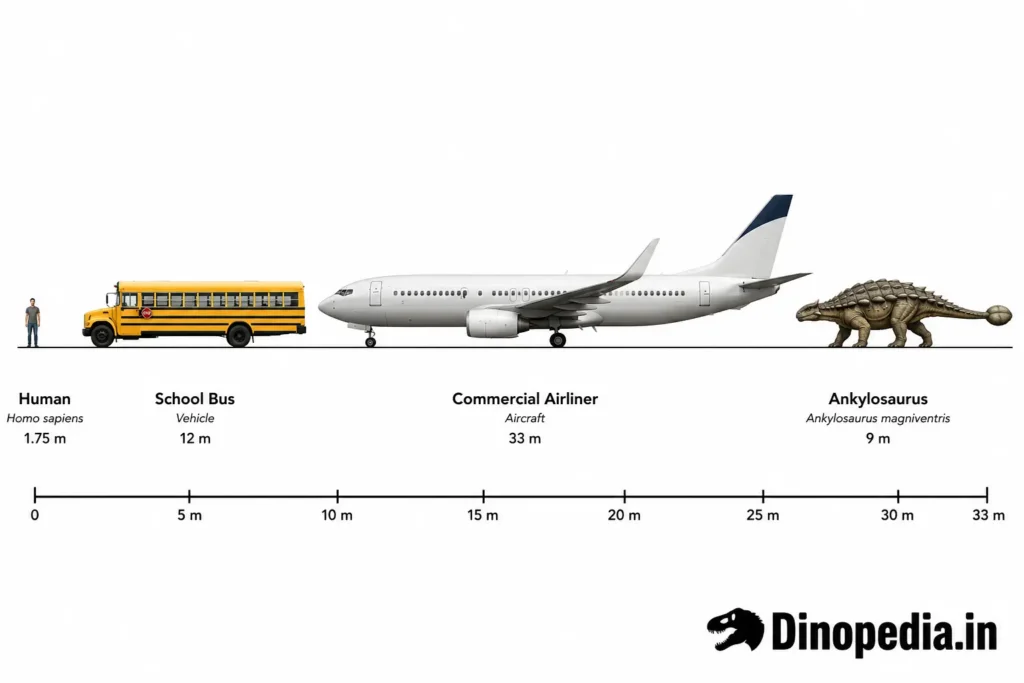
| Length | Approximately 6–8 metres, with some estimates slightly larger — about the length of a large van to a single school bus |
| Weight | Estimated at roughly 5–8 tonnes, though exact mass remains uncertain due to incomplete fossil remains — the weight of one to nearly two African elephants, though estimates vary because no complete skeleton has ever been found |
| Diet | Plants — low-growing vegetation, processed with a beak and small leaf-shaped teeth |
| Speed | Slow. Built for protection, not pace — a heavily armoured quadruped moving at a deliberate, ground-hugging walk |
Fun Facts
It was essentially covered head to toe in bone
The armour on Ankylosaurus — called osteoderms — wasn’t just on its back. Bony plates, knobs, and spikes covered its sides, its neck, and even its eyelids. Each eyelid had its own bony shield. This wasn’t decoration: it was a full-body defensive system evolved over millions of years, and it made Ankylosaurus extremely well protected from attacks directed at its upper body.
Its tail ended in a solid mass of fused bone
The tail club was formed by vertebrae that had fused and were encased in large bony plates, creating a dense, heavy knob. The handle section — the stiffened part of the tail leading up to the club — locked the whole structure into a rigid lever. Biomechanics research on close relatives suggests that a large club like this. Biomechanical studies of close ankylosaur relatives suggest large tail clubs may have generated enough force to fracture bone under certain conditions. Whether Ankylosaurus used it against predators, rivals of its own species, or both, is still genuinely uncertain.
No fully complete Ankylosaurus skeleton has been discovered
Everything we know about Ankylosaurus comes from partial remains — skulls, armour fragments, and sections of skeleton, but never the whole animal in one place. This means size and weight estimates carry real uncertainty. It’s likely the largest member of its family, but pinning down exactly how large involves educated inference from the pieces we have.
Shared Late Maastrichtian ecosystems with Tyrannosaurus rex — and survived, at least for a while
Ankylosaurus was a contemporary of Tyrannosaurus rex in the same ecosystems. It also shared its world with Triceratops and Edmontosaurus. It’s one of the last non-bird dinosaurs in the fossil record, surviving right up to the mass extinction 66 million years ago.
Its nostrils were unusually complicated
The nasal passages of Ankylosaurus were remarkably convoluted — looping through the skull in a way that’s unlike most dinosaurs. What this was for isn’t certain. Theories include regulating the temperature and moisture of inhaled air, or Hypotheses include thermoregulation, moisture conservation, and possibly acoustic functions, though these remain debated. The fossil record can show the shape of the passages; what happened inside them is harder to know.
It was probably rare in its own ecosystem
Despite being one of the most famous dinosaurs, Ankylosaurus appears to have been genuinely uncommon in the environments where its fossils are found. It may have lived in upland areas slightly removed from the lowland floodplains where most Hell Creek fossils are concentrated — which could explain why relatively few specimens have turned up.
The armour was embedded in the skin, not attached to the skeleton
Ankylosaur osteoderms sat within the skin rather than being directly connected to the bones underneath. This meant the armour formed a flexible outer layer rather than a rigid shell — The osteoderms were embedded in the skin rather than fused directly to the skeleton. It also means the armour rarely fossilises in the same position it was in life, which makes reconstruction tricky.
Did You Know — Could T. rex Actually Crack It Open?
An adult Ankylosaurus would have presented a formidable challenge to large predators. Its heavy armour and low body profile reduced vulnerable target areas, while the tail club may have served as a defensive deterrent. However, direct evidence of predator-prey interactions between Ankylosaurus and Tyrannosaurus rex remains limited.
Myths & Movie Moments
In Jurassic World: Fallen Kingdom, an Ankylosaurus gets thrown into a lava lake. A memorable scene, if not a dignified one. The film at least gets the general shape right — stocky, armoured, club-tailed. What it doesn’t capture is that Ankylosaurus was a slow, deliberate animal built for passive defence, not the panicked running creature the film needed for its set piece.
People assume the tail club was definitely used against T. rex. This is the go-to image in dinosaur books, and it might be right — but it’s not settled. The research on tail club mechanics was done on Euoplocephalus and other relatives, not Ankylosaurus directly. And even that research concluded only that the club could break bones in the right conditions, not that it was specifically used for predator defence rather than, say, competing with other Ankylosaurus. Both uses are plausible. Neither is confirmed.
Ankylosaurus is often used to represent all armoured dinosaurs. It’s the famous one, but the armoured dinosaur group was large and varied. Nodosaurids — a related family — had no tail club at all and were quite different in build. Ankylosaurus is unusual, not typical. Calling every armoured dinosaur an “Ankylosaurus” is a bit like calling every big cat a lion.
Early reconstructions showed it looking like an armoured Stegosaurus. When Barnum Brown first described Ankylosaurus in 1908, the tail club wasn’t yet known, and he reconstructed it with a short drooping tail and a strongly arched back based on Stegosaurus comparisons. That reconstruction stayed influential for decades. The animal we picture today — low-slung, club-tailed, wide and flat — looks substantially different.
What If It Appeared Today?
Drop Ankylosaurus into the forests and grasslands of Montana — close to where its fossils were actually found — and it would very likely find food without difficulty. It was a low browser, and modern ground-level vegetation would probably suit its beak and teeth reasonably well, though how its digestive system would handle today’s plant species is genuinely uncertain. Modern predators would almost certainly leave it alone entirely: wolves, mountain lions, and bears have no framework for dealing with an animal this size and this heavily armoured. The most plausible consequence for the local ecosystem would be significant physical disturbance — an animal of this weight moving slowly through woodland, eating steadily, would reshape the vegetation around it. It’s reasonable to think it would thrive in the absence of any predator capable of threatening it.
Could You Keep One as a Pet?
🔴 Absolutely not.
Temperament-wise, Ankylosaurus wasn’t aggressive in the way a large theropod would be — it was a plant-eater with no interest in hunting you. The problem is everything else. It weighed several tonnes and moved with the awareness of something that knew nothing could hurt it. The tail club is the real issue: Ankylosaurus didn’t aim it carefully. It swung. Anything within range — fences, cars, walls, you — is equally irrelevant to an animal that evolved this weapon over millions of years of not needing to be precise. Your garden would be gone within a day. Your house would follow shortly after, not through malice but through the ordinary business of a multi-tonne animal moving around. The bony eyelids are cool though.
Verdict: 🔴
Want the full science — the Hell Creek fossil sites, the biomechanics of the tail club, and everything researchers know about how Ankylosaurus actually lived and what its armour was made of? ExtinctAtlas has all of it →
Final Thought
There’s something quietly extraordinary about an animal so committed to not being eaten that it armoured its own eyelids. Ankylosaurus didn’t need speed or aggression — it needed to be something a predator looked at and decided wasn’t worth the trouble. For millions of years, right up to the very end, that strategy worked.
More From the Late Cretaceous


Ready for the full scientific deep dive? Read the ExtinctAtlas guide on Ankylosaurus →