

Brachiosaurus (BRACK-ee-oh-SORE-us)
Picture the largest animal you’ve ever seen. Now double it, give it a neck like a construction crane, and put it in a forest where even the tallest trees were snacks.
BRACK-ee-oh-SORE-us — “BRACK-ee-oh-SORE-us”
Fast Facts
| When | Around 150–145 million years ago — Late Jurassic, back when North America was a warmer, wetter place and the Rocky Mountains were only just beginning to rise |
| Where found | Colorado and Utah, USA — the famous Morrison Formation, one of the world’s richest dinosaur fossil sites |
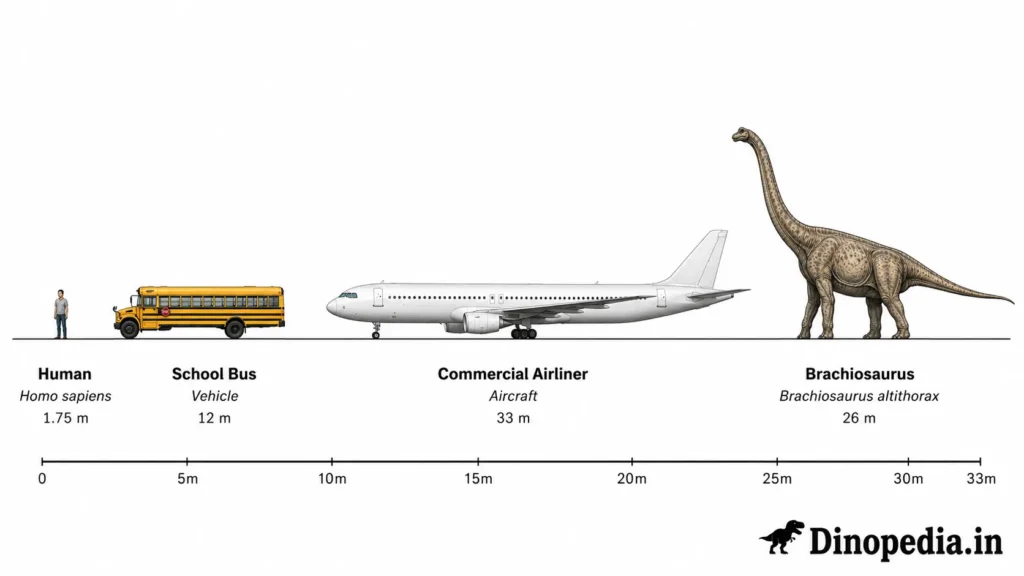
| Length | Around 20–26 metres — roughly the length of two school buses, nose to tail |
| Weight | Estimates vary significantly: somewhere in the range of 30–56 tonnes, depending on the model. That’s somewhere between five and ten large African elephants |
| Diet | Plants — high-canopy conifers, ginkgos, cycads, ferns |
| Speed | A slow, steady walker. Built for endurance and reach, not pace — probably comparable to a brisk human walk at best |
Fun Facts
Its front legs were longer than its back legs — on purpose
Most sauropods slope gently downward from hips to shoulders. Brachiosaurus does the opposite: its forelimbs were longer, which tilted the whole body upward from the hips and gave the neck a natural head-start toward the treetops. It’s this feature, more than anything else, that made Brachiosaurus well-suited for higher browsing. The name literally means “arm lizard,” in honour of those oversized front limbs.
It could lift its head roughly as high as a four-storey building
By combining the upward-sloping body with a long neck, Brachiosaurus could potentially browse at heights few other animals — then or now — could reach. Scientists debate exactly how high it typically held its neck (more on that below), but even at a moderate angle, it was operating in a feeding zone none of its competitors could access.
Its cardiovascular system remains a major scientific question.
Supplying blood to a head held high above the heart would have posed significant physiological challenges. Exactly how large Brachiosaurus’s heart was, and how its cardiovascular system functioned, remains uncertain because soft tissues do not fossilise. Researchers have proposed various models, but the mechanics of blood pressure regulation in giant sauropods are still debated.
It shared its world with some of the most famous dinosaurs ever found
The Morrison Formation — the stretch of western North America where Brachiosaurus fossils were found — was also home to Allosaurus, Stegosaurus, Diplodocus, and Apatosaurus. They all lived at roughly the same time in the same general region. It was, by any measure, one of the most spectacular ecosystems the planet has produced.
Its teeth were shaped like chisels.
Brachiosaurus didn’t chew. Its spatula-shaped teeth were built for stripping leaves and vegetation from branches — bite, strip, swallow, repeat. Digestion happened later, with the help of bacteria breaking down tough plant matter deep in the gut. It’s the same basic approach used today by horses and elephants, scaled up enormously.
Adult size likely provided substantial protection
A fully grown Brachiosaurus would have been an enormously challenging target for contemporary predators such as Allosaurus. Its sheer size alone likely acted as a major deterrent. Juvenile sauropods, being much smaller and less physically imposing, would almost certainly have faced greater predation risk, although direct fossil evidence specifically involving Brachiosaurus is limited.
It may have travelled in herds — or may not have
Trackway evidence from sauropods suggests some species moved in groups. Whether Brachiosaurus specifically did is unclear from the fossil record. The image of a slow-moving herd of giants browsing through a Jurassic forest is plausible, but it’s reasonable to hold it as a possibility rather than a certainty.
Did You Know — How Did Brachiosaurus Hold Its Neck?
Neck posture in sauropods remains an active area of scientific debate. For much of the 20th century, Brachiosaurus was commonly reconstructed with its neck held steeply upright, creating the familiar “living crane” image. Later biomechanical studies suggested a more neutral or moderately elevated posture may have been more realistic, while other researchers have argued that higher browsing postures remained anatomically possible. What is clear is that Brachiosaurus was adapted for feeding higher than many contemporary herbivores, even if the exact habitual neck angle remains uncertain.
Myths & Movie Moments
The Brachiosaurus in Jurassic Park is almost certainly Giraffatitan
This is the big one. The famous scene where Dr. Grant and Ellie Sattler first see the herd — the animal that rears up on its hind legs, the one that sneezes on Lex — is modelled on the spectacular skeleton mounted in Berlin’s Natural History Museum. That skeleton is Giraffatitan brancai, an African relative that was classified as a species of Brachiosaurus for decades before being separated into its own genus. The two animals were similar but distinct: different skull shape, different body proportions, different continents. The name “Brachiosaurus” stuck in the film and in popular culture, but the animal you’re picturing is most likely Giraffatitan. It’s a mix-up that even museum labels got wrong for years.
Brachiosaurus was not a water animal.
Older reconstructions — right through the mid-20th century — showed sauropods wading in lakes and swamps, their enormous weight supposedly needing buoyancy to support it. This is now thoroughly outdated. Brachiosaurus had strong, pillar-like legs, lightweight air-filled bones, and a skeleton clearly adapted for terrestrial life. Submerging it deep enough to support its weight would have made breathing impossible. It lived on land, full stop.
The famous rearing scene is highly speculative.
Popular depictions have sometimes shown Brachiosaurus rearing dramatically onto its hind limbs. Given its body proportions, especially its relatively front-heavy build, many palaeontologists consider this unlikely or biomechanically difficult, though exact locomotor limits remain uncertain.
The skeleton you’ve seen in museums might not be labelled correctly
For much of the 20th century, Giraffatitan fossils were displayed and catalogued as Brachiosaurus. The reclassification happened gradually, and some museum materials were slower to update than others. If you’ve visited a natural history museum and seen a “Brachiosaurus” mount, it’s worth checking which animal it actually is.
What If It Appeared Today?
If Brachiosaurus somehow existed in a modern environment, its ecological impact would be extraordinary. An animal of this size would consume vast amounts of vegetation and physically alter landscapes through browsing and movement alone. However, predicting how well it would adapt to modern ecosystems is highly speculative, as today’s plant communities differ significantly from those of the Late Jurassic.
Modern predators — mountain lions, wolves, even bears — would very likely give a fully grown individual a wide berth entirely. The most unexpected consequence for the local ecosystem would probably be the sheer volume of vegetation consumed and the physical impact of an animal this heavy moving through woodland. It’s reasonable to think entire sections of forest would be reshaped by a small group of them within a matter of years.
Could You Keep One as a Pet?
💀 You wouldn’t even get to try.
Start with the garden: you’d need several acres of mature forest, and it would be gone within days. Housing is a non-starter — a Brachiosaurus stood taller than most buildings you’ve been in. Feeding it would mean sourcing enormous quantities of vegetation daily, continuously, in volumes that would challenge a dedicated agricultural operation. And that’s before you consider what happens when an animal weighing as much as multiple elephants walks across your driveway. The good news is that Brachiosaurus had no interest in eating you. The bad news is that it might simply not notice you were there.
Verdict: 💀
Curious about the real science? Read the full guide to Brachiosaurus.
Final Thought
Something is humbling about an animal so large that its heart alone may have outweighed a horse. Brachiosaurus wasn’t the biggest dinosaur ever found — that title belongs to the titanosaurs — but it was among the first to show the world just how far evolution could push the idea of a land animal. Standing in a Jurassic forest, head somewhere above the treetops, it must have looked less like a creature and more like a feature of the landscape.
More From the Late Jurassic



Ready for the full scientific deep dive? Read the ExtinctAtlas guide on Brachiosaurus →