

The Dinosaur That Spent a Century Wearing the Wrong Head
For decades, museum visitors around the world stood in front of Apatosaurus and admired it, with a completely wrong skull bolted to its neck. A squarish, snub-nosed head from an entirely different dinosaur. The actual Apatosaurus head is narrow, long, and peg-toothed, much more like a horse than a bulldozer. One of the most famous animals that ever lived, and science got its face wrong for most of the 20th century.
Ah-PAT-oh-SAWR-us — “ah-PAT-uh-SAWR-us”
Fast Facts
| Time period | Late Jurassic, around 152–151 million years ago — the same world as Allosaurus, Stegosaurus, and Diplodocus |
| Fossils found | Colorado, Utah, Wyoming, Oklahoma, New Mexico (USA) |
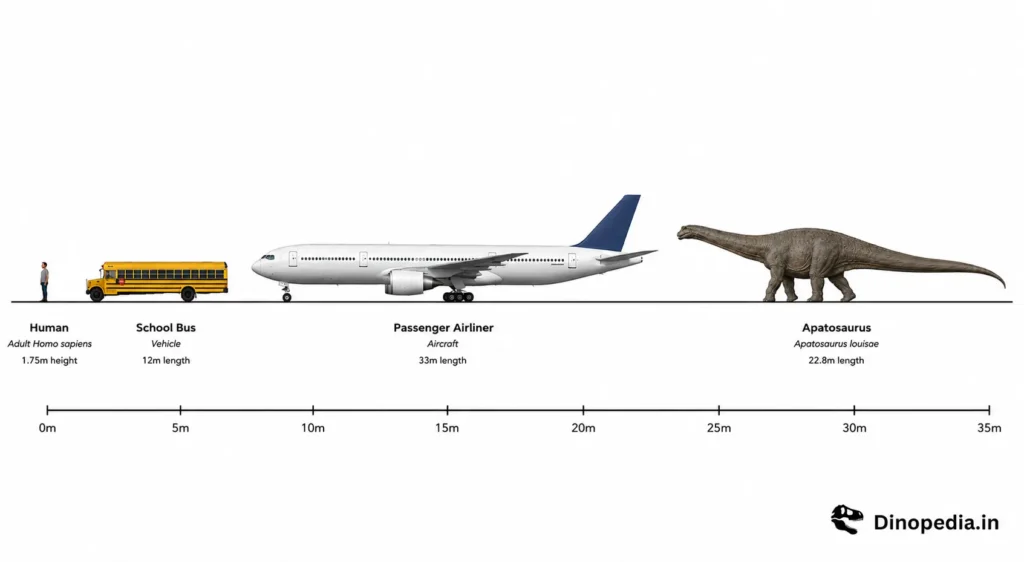
| Length | Around 69–75 feet — roughly two school buses end to end |
| Weight | 16–22 tons — the same as four or five African elephants |
| Diet | Plants |
| Speed | Slow-moving — built for steady movement rather than speed, though exact walking pace remains uncertain |
Fun Facts
It displayed the wrong head in museums for roughly 70 years
When the Carnegie Museum first mounted its Apatosaurus skeleton in 1905, no confirmed Apatosaurus skull had been found. So they used a cast of a Camarasaurus skull — a different dinosaur with a boxy, blunt snout. This version of Apatosaurus appeared in books, toys, and public imagination for decades. The correct skull — long, narrow, with pencil-like teeth — wasn’t officially recognised and mounted until the late 1970s.
It is also Brontosaurus — sort of
In 1877, paleontologist Othniel Charles Marsh named Apatosaurus. Two years later, racing to outdo his rival, he named a larger, more complete specimen Brontosaurus. A scientist identified the mix-up in 1903: they were the same animal. Since Apatosaurus was named first, it took priority, and Brontosaurus was retired — in science, if not in popular culture. Then, in 2015, a major study of 81 sauropod skeletons concluded that Brontosaurus was actually distinct enough to be its own genus after all. The debate continues.
It was neck and neck with Allosaurus — literally.
Apatosaurus lived in the same time and place as Allosaurus. Fossil evidence shows interaction between the two, including bite marks attributed to Allosaurus on Apatosaurus bones. Juveniles or weakened individuals were likely more vulnerable, while a healthy adult Apatosaurus would have been an extremely risky target for any predator.
Its bones had hollow chambers to reduce weight.
Like birds, Apatosaurus had vertebrae with air pockets built into the bone. Without these, supporting a neck that could extend to 18 feet would have required even more mass. The hollow structure saved enormous amounts of weight while maintaining structural strength.
Its neck was probably held more horizontally than vertically.
Classic images show Apatosaurus craning its neck skyward like a giraffe. Biomechanical analysis of the vertebrae suggests horizontal or slightly elevated posture was more natural — sweeping the neck side to side to cover a wide feeding area rather than reaching up. Some researchers argue it had more range than this, but the full-vertical giraffe pose is likely an overstatement.
It was one of the most heavily built sauropods of its time
Apatosaurus was stockier and more robustly built than close relatives like Diplodocus. Its neck was thicker, its bones more massive. This wasn’t just size — it was structure. Apatosaurus was built heavier than it needed to be for pure length.
It hatched from eggs roughly the size of a football
Despite growing to more than 20 tons, Apatosaurus began life small enough to fit in two hands. Growth was extraordinarily rapid in early life — young Apatosaurus needed to get much bigger, much faster, in a world full of predators.
Did You Know — Was It Actually Brontosaurus?
It depends on the year you ask.
From 1903 to 2015, the scientific answer was no — Brontosaurus was a naming error, and everything called Brontosaurus was technically Apatosaurus. But a 2015 study examined 81 sauropod skeletons in detail and concluded that the differences between the two were real and consistent enough to warrant separate genera. Under that analysis, Brontosaurus was valid again.
Not everyone agrees. Some paleontologists think the differences are too minor to justify splitting them. The name you use now signals which side of the debate you find more convincing — which is an odd situation for what is essentially one of the most studied dinosaurs in history.
Myths & Movie Moments
The wrong skull — everywhere, for decades
The boxy, snub-nosed Apatosaurus of films, children’s books, and the classic Land Before Time character Littlefoot draws on the Camarasaurus skull era. The real skull is much longer and more slender. Most pop culture depictions still use the old, wrong version by default, because it’s been the image for so long.
It was a swamp-dweller
Early 20th-century science assumed Apatosaurus was too heavy for land and must have lived half-submerged in water to support its bulk. This was confidently wrong. Footprint evidence, skeletal analysis, and biomechanical modelling all confirm it was entirely terrestrial — a land animal that walked on solid ground, not a wader. The legs were built like load-bearing columns.
Brontosaurus is just a nickname for Apatosaurus.
Not quite — and increasingly not at all. Brontosaurus has potentially been rehabilitated as a genuine separate genus since 2015. Using them interchangeably is now, depending on who you ask, somewhere between a simplification and an actual error.
It was slow-witted and passive.
Apatosaurus is often portrayed as a lumbering, mindless grazer. Its brain was small relative to its body, but that’s true of large sauropods generally, and brain-to-body ratio is a poor guide to behaviour in enormous animals. Apatosaurus was a highly successful animal that persisted for millions of years in predator-filled ecosystems. Calling it simply passive misses the reality of an animal built to survive on a colossal scale.
What If It Appeared Today?
An Apatosaurus appearing in the floodplains of modern Colorado or Wyoming would enter a landscape dramatically different from the Jurassic. Whether its digestive system could handle modern vegetation — very different from the ferns and conifers it evolved with — is genuinely uncertain.
If it could adapt, it would very probably be an ecological giant. A healthy adult would likely have few natural predators among modern land animals. It would almost certainly require enormous quantities of food, and even a small group could significantly alter local vegetation.
The most striking consequence: it’s reasonable to think modern infrastructure, agriculture, and ecosystems would struggle to accommodate an animal of this scale.
Could You Keep One as a Pet?
Size: Up to 75 feet long, 20 tons. This is not a manageable animal in any residential context on Earth.
Enormous quantities of vegetation — far beyond what any household, farm, or zoo could realistically supply. Your garden is a single snack. Your neighbourhood’s trees are maybe a week old.
Temperament: Probably not aggressive. But an accidental step from an animal weighing as much as five elephants ends the same way as a deliberate one.
The specific problem: Its eggs were football-sized. You cannot manage a baby version either. There is no starter Apatosaurus.
Modern equivalent: A five-elephant-equivalent lawnmower that moves slowly, eats everything, and doesn’t know you’re there.
Verdict: 💀 You wouldn’t even get to try — there is no facility on Earth capable of housing one, and the logistics of feeding it would constitute a national emergency.
Final Thought
Apatosaurus spent nearly a century looking at us through someone else’s face. There’s something almost poetic in that — one of the most colossal animals that ever walked the planet, and we still couldn’t quite see it clearly. It took over a hundred years to find the right skull, another decade to sort out the name, and scientists are still arguing about whether Brontosaurus exists. The animal just keeps resisting easy answers.
More Creatures You May Like

Ready for the full scientific deep dive? Read the ExtinctAtlas guide on Apatosaurus →