

The Longest Animal That Ever Walked on Land
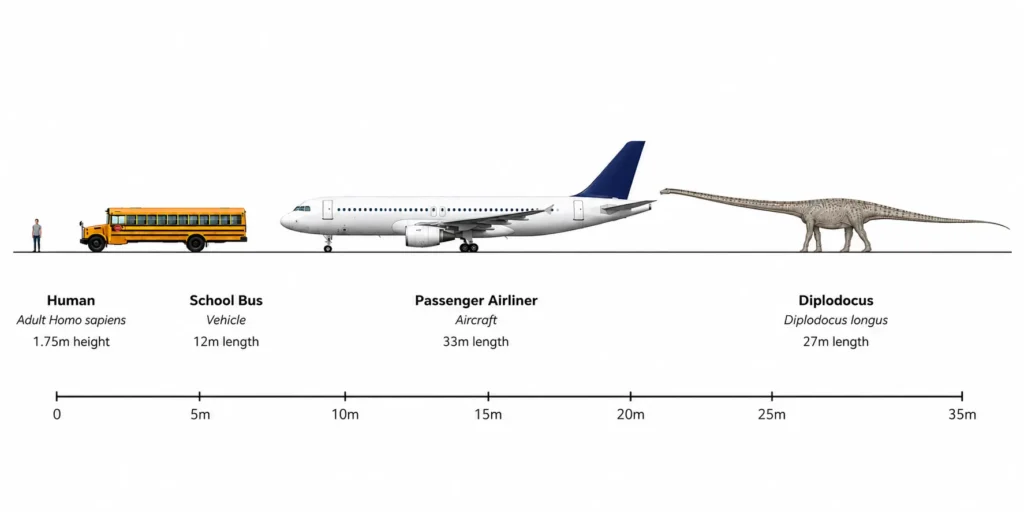
Picture a creature so long that its tail alone was roughly the length of a school bus. That was Diplodocus — and the tail was still just one end of it. From tip to tip, this animal stretched the length of two and a half double-decker buses placed end to end. Nothing that has ever walked on land has been confidently measured longer.
Dip-LOD-oh-kus — “dip-LOD-uh-kus”
Fast Facts
| Field | Info |
|---|---|
| Time period | Late Jurassic, around 154–145 million years ago — roughly the same era as some of the earliest birds |
| Fossils found | Colorado, Utah, Wyoming, Montana (USA) — all within the Morrison Formation |
| Length | Around 85–90 feet — roughly two and a half school buses |
| Weight | Estimates vary, but typically 10–17 tons — somewhere between two and four African elephants |
| Diet | Plants |
| Speed | Likely slow-moving compared with fast predators, though exact walking speed remains uncertain |
Fun Facts
Its teeth were basically combs
Diplodocus had a mouthful of pencil-thin, peg-like teeth — but only at the very front of its jaw. It couldn’t chew. Researchers think it likely stripped vegetation from branches and swallowed plant material whole, relying on digestion rather than chewing.
It may have had spines down its back.
Fossil skin impressions suggest Diplodocus possibly had a row of narrow, conical, keratinous spines running down its back, some up to 18 cm tall. What they were for isn’t known. Display, species recognition, or something else entirely. Their discovery surprised palaeontologists.
The “supersonic tail” idea is now seriously disputed.
A 1997 study proposed that Diplodocus could crack its tail like a whip — fast enough to break the sound barrier and produce a sonic boom. It was a brilliant idea, and became famous. A 2022 study using more detailed computer modeling found that real bone and tissue couldn’t reach those speeds without catastrophic damage. The tail was still a formidable weapon, just probably not a supersonic one.
Babies ate differently from adults.
Fossils from younger diplodocid sauropods suggest juveniles may have eaten somewhat differently from adults, possibly selecting softer or different vegetation before shifting toward adult feeding strategies as they grew.
A billionaire made it the most famous dinosaur in Europe.
In 1905, Andrew Carnegie — one of the wealthiest people in American history — paid to have a full plaster cast of a Diplodocus skeleton shipped to the Natural History Museum in London, at the personal request of King Edward VII. Carnegie then sent copies to museums across Europe. For decades, Diplodocus was the face of dinosaurs to millions of people who had never heard of T. rex.
Its name means “double beam” — and has nothing to do with its neck
The name refers to bones on the underside of the tail with a distinctive double-beam shape. Not the neck. Not the body. The tail bones. When Othniel Charles Marsh named it in 1878, he thought only Diplodocus had them. Later discoveries found the same bones in many other long-necked dinosaurs.
It held its neck more or less horizontally.
Classic illustrations show Diplodocus craning its neck up like a giraffe to browse treetops. Biomechanical analysis suggests this probably wasn’t its natural resting posture — the neck was more likely held roughly horizontal, sweeping low and wide across vegetation rather than reaching up. Some researchers debate how much flexibility it had, but the straight-up giraffe pose is likely an oversimplification.
Did You Know — Would a Predator Actually Attack One?
Diplodocus shared its world with Allosaurus — a serious, well-armed predator. So was Diplodocus in danger?
Fully grown Diplodocus would have been dangerous prey. Its sheer size and powerful tail likely made healthy adults difficult targets, though large predators such as Allosaurus may still have attacked vulnerable individuals under the right circumstances.
Myths & Movie Moments
The neck-up giraffe pose.
Every museum display and children’s book for most of the 20th century showed Diplodocus with its neck raised high, head level with the treetops. Biomechanical work on the skeleton and vertebrae suggests this probably wasn’t its natural posture. The neck was most likely held more horizontally, sweeping side to side at a lower feeding height. The dramatic vertical pose is almost certainly wrong — though how much vertical range it had is still debated.
It dragged its tail
Early reconstructions had the tail trailing along the ground. Fossil trackways of sauropods show no tail-drag marks. The tail was held up. In fact, the Natural History Museum in London corrected Dippy’s tail position in 1993 — lifting it off the floor — after decades of displaying it incorrectly.
It was dim and passive.
Diplodocus is often portrayed as a slow, lumbering, unresponsive animal — essentially a living hill. Its brain-to-body ratio was indeed very small, but the size of the brain relative to body is a poor guide to behaviour in animals this large. It was a highly successful animal that survived for millions of years and possessed sensory systems and defensive behaviours that were clearly effective.
It’s not the same as Brontosaurus or Apatosaurus.
Diplodocus, Brontosaurus, and Apatosaurus are three different dinosaurs. All long-necked, all from the Morrison Formation, all Jurassic — but genuinely distinct. Mixing them up is like mixing up lions, tigers, and leopards because they’re all big cats.
What If It Appeared Today?
A Diplodocus appearing in modern Wyoming or Colorado would find a dramatically changed landscape — drier, cooler, with very different plant life from the ferns and conifers of the Jurassic.
Whether its digestive system would be compatible with modern grasses and flowering plants is genuinely uncertain. If it could adapt, it would very likely strip enormous quantities of vegetation from whatever territory it moved through. A healthy adult would likely have few, if any, natural predators among modern land animals.
The most striking consequence: it’s reasonable to think one individual would reshape the vegetation of a substantial area, simply by the scale of what it consumed and displaced. A herd would be an ecological event.
Could You Keep One as a Pet?
Size: At 85 feet long, it would not fit in your house, your garden, or your street. It would fit in a small stadium, with difficulty.
Diet: Enormous quantities of vegetation, stripped from branches it could reach without effort. Your trees would be gone by Tuesday.
Temperament: Probably not aggressive — but a tail that may have been swung as a defensive weapon doesn’t need intent to cause serious damage. It might not notice you.
The specific problem: Even a juvenile would still be an enormous animal by modern standards.
Modern equivalent: A very serene, extraordinarily large lawnmower that occasionally destroys things without meaning to.
Verdict: 💀 You wouldn’t even get to try — there is nowhere in the world you could house one, and the liability insurance alone would end you.
Final Thought
Diplodocus walked the earth for millions of years, and we still argue about which way it held its neck. There is something genuinely humbling about that — one of the most studied, most displayed, most recognisable animals in the history of palaeontology, and its basic posture is still a live debate. The skeleton that made it famous stands in museums on five continents. The animal itself remains, in important ways, a mystery.
More Creatures You May Like

Ready for the full scientific deep dive? Read the ExtinctAtlas guide on Diplodocus →