

One of the dominant apex predators of the Late Jurassic
Before T. rex ever existed, Allosaurus ruled. For millions of years, it was the top predator across a landscape that would become the American West — a massive, agile hunter with a skull built like a weapon and teeth that never stopped growing back.
Al-oh-SAWR-us — “al-oh-SAWR-uss”
Fast Facts
| Time period | Late Jurassic, roughly 155–145 million years ago — when western North America looked very different, with broad floodplains, seasonal rivers, and lush fern-covered landscapes |
| Fossils found | Utah, Colorado, Wyoming, Montana (USA); also Portugal |
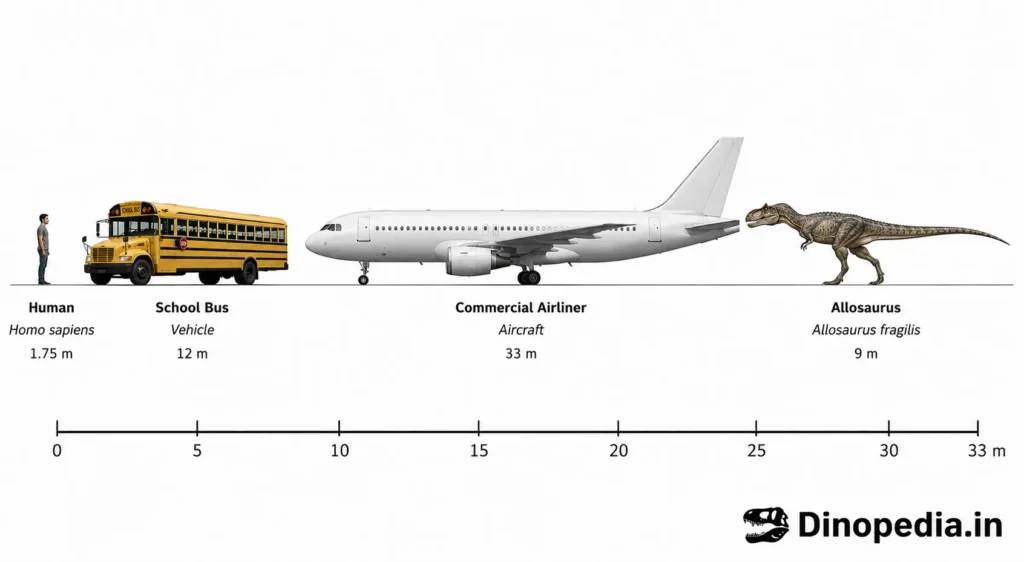
| Length | Around 28–32 feet for most adults — about the length of two cars end to end. Some specimens may have reached 40+ feet |
| Weight | 2–3 tons — roughly the same as a large rhinoceros |
| Diet | Meat |
| Speed | Fast enough to be a serious threat — its build suggests an active predator capable of pursuing prey, though exact speed remains uncertain |
Fun Facts
Its bite may have been surprisingly modest for an animal of its size
Allosaurus had a surprisingly low bite force for its size. A lion bites harder. But its skull could absorb enormous downward force, which suggests it attacked differently: opening its jaws wide and driving its upper teeth into prey like a blade. Scientists debate exactly how this worked — the “hatchet jaw” idea has been challenged and refined — but the skull was clearly built for something unusual.
It had horns above its eyes
Two small bony crests sat just above each eye, varying slightly between individuals. They may have been used to recognise other members of the species, attract mates, or both. These crests may have helped Allosaurus recognise rivals or potential mates.
Its teeth were basically self-replenishing
Like most dinosaurs, Allosaurus shed and regrew its teeth continuously throughout its life. Loose Allosaurus teeth are among the most common fossils in the Morrison Formation, which tells you something about how often it was biting things.
Young and adult Allosaurus may have lived very different hunting lifestyles
Young Allosaurus had proportionally longer legs and were likely faster, probably hunting smaller prey. As they grew, their legs became stockier, and they shifted toward larger targets. As they grew, their hunting strategies likely changed dramatically.
A Stegosaurus once killed one
Fossil evidence includes an Allosaurus pelvis bone with a puncture wound in the exact shape of a Stegosaurus tail spike — and no sign of healing. The injury appears to have been fatal. The prey fought back and won.
It may have eaten its own kind
Evidence from multiple dig sites — including shed Allosaurus teeth found near Allosaurus bones — suggests possible cannibalistic feeding. Whether this was active predation or scavenging on already-dead individuals isn’t settled.
It’s Utah’s state fossil
Allosaurus is officially the state fossil of Utah, largely thanks to the Cleveland-Lloyd Quarry — one of the most extraordinary Jurassic fossil sites ever discovered, where around two-thirds of all fossils belong to Allosaurus.
Did You Know — Could It Take Down a Sauropod Alone?
Apatosaurus could weigh 20 to 30 times as much as Allosaurus. So how did a predator that size hunt animals that enormous?
It very likely didn’t charge in and overpower them. If Allosaurus hunted giant sauropods, it likely focused on younger, weaker, or vulnerable individuals. Its wide-gaping jaws and powerful neck muscles were well-suited to delivering slashing wounds and retreating, more attrition than brute force. Bite marks on sauropod bones confirm it was eating them. Whether it was killing them cleanly or waiting them out is still debated.
Myths & Movie Moments
It’s always the sidekick
Allosaurus dominated its world for roughly 10 million years — far longer than T. rex existed at all. But in popular culture, it’s often reduced to a supporting role. It appears in The Valley of Gwangi, Walking with Dinosaurs, and various Jurassic Park games, usually playing second fiddle to T. rex despite being the actual ruler of the Jurassic.
It wasn’t slow or lumbering
The “giant lizard dragging its tail” image belongs to early 20th-century illustration, not science. Allosaurus walked upright with its tail off the ground for balance, and its leg structure suggests it was an active terrestrial predator.
It wasn’t T. rex’s ancestor
They’re not closely related — and they lived 76 million years apart. Saying Allosaurus was “like a Jurassic T. rex” is a bit like calling a wolf “a prehistoric dog.” Broadly similar body plan, very different animal, completely different era.
Feathers? Genuinely uncertain
Some pop science articles confidently give Allosaurus a feathery coat. The honest answer: no feather impressions have been found for Allosaurus. Direct skin evidence for Allosaurus is limited, and no confirmed feather impressions have been found. Juveniles may possibly have had some filament-like covering, but this remains speculative.
What If It Appeared Today?
An Allosaurus appearing in the American West — modern Utah or Wyoming — would find terrain it once knew, now significantly changed.
Modern North American herbivores might offer plausible prey opportunities: bison, elk, and pronghorn are all within a plausible size range for a predator of this scale, though whether modern plants would be digestible for prey species it targeted is a separate question. Few modern predators would compete directly with something its size from existing North American predators — wolves, mountain lions, and bears would very likely give it a wide berth.
The more interesting consequence: it’s reasonable to think large herbivore populations in the region could be significantly disrupted, with cascading effects on vegetation and smaller animals. One apex predator of this size reshapes an entire ecosystem.
Could You Keep One as a Pet?
Diet: An adult Allosaurus would need enormous quantities of meat — well beyond what a household, or a neighbourhood, could realistically source. Daily.
Size: Your house would not work. Your garden would not work. Your street would be a problem.
Temperament: Fossil injuries to Allosaurus forelimbs suggest it regularly wrestled with large, struggling prey. You are not large prey. You are a snack.
The specific issue: It could open its jaws remarkably wide. Most doors are not that wide. Most doors would also not stop it.
Modern equivalent: An extremely large, operationally dangerous bird of prey that has stopped caring about consequences.
Verdict: 🔴 Absolutely not — you would be a curiosity, briefly, and then lunch.
Want the full science? ExtinctAtlas has everything researchers know about Allosaurus — diet, anatomy, behaviour, and the fossil evidence behind it all →
Final Thought
Allosaurus fossils are so abundant that paleontologists have studied individuals from hatchling to old age, tracing how the same animal changed its entire way of hunting as it grew. It’s one of the best-studied large predatory dinosaurs ever discovered. And yet the Cleveland-Lloyd Quarry — thousands of Allosaurus bones, piled in the Utah desert — still doesn’t have a fully agreed explanation for how they got there. Even the best-known dinosaur keeps its secrets.
More From the Late Jurassic



Ready for the full scientific deep dive? Read the ExtinctAtlas guide on Allosaurus →