

The Dinosaur That Started Everything
Before T. rex, before Jurassic Park, before the word “dinosaur” even existed — there was Iguanodon. It was only the second dinosaur ever scientifically named. Its teeth, found by the side of a road in Sussex in 1822, helped convince the world that giant reptiles had once ruled the Earth. And on New Year’s Eve 1853, 21 men sat down to a seven-course dinner inside one.
Ig-WAN-oh-don — “ig-WAN-uh-don”
Fast Facts
| Field | Info |
|---|---|
| Time period | Early Cretaceous, around 126–122 million years ago — when flowering plants were only just beginning to appear |
| Fossils found | Belgium, England, Germany, Spain — most fossils from Western Europe |
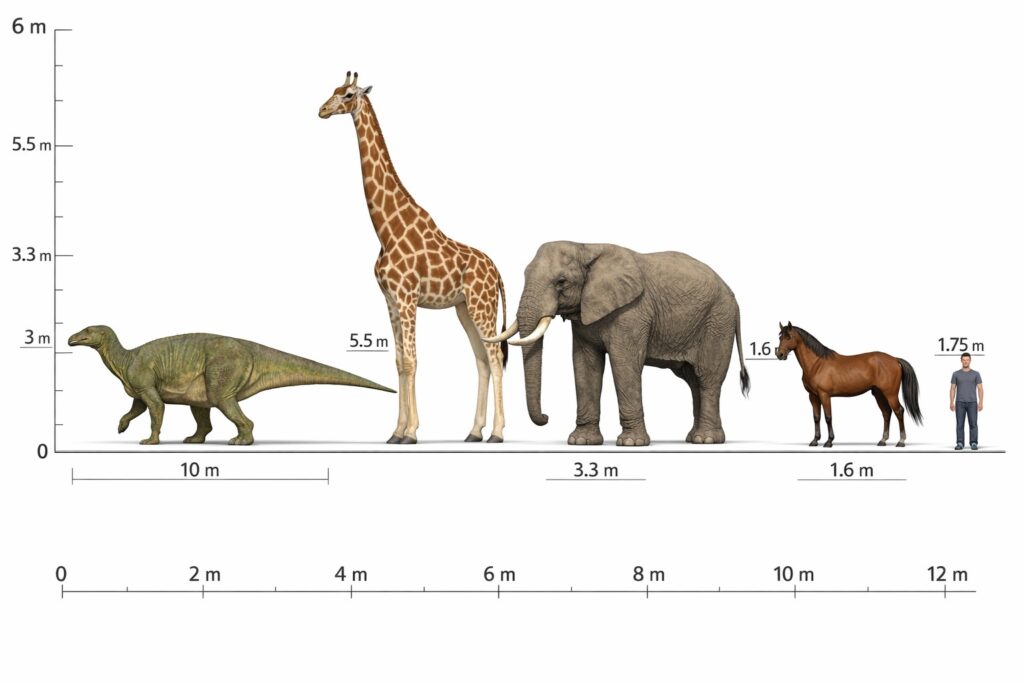
| Length | Around 30–36 feet — roughly the length of a large bus |
| Weight | Around 4–4.5 tons — roughly the same as a large African elephant |
| Diet | Plants |
| Speed | Moderate — legs built for sustained movement rather than sprinting, capable of both bipedal and four-legged locomotion |
Fun Facts
Scientists held a New Year’s Eve dinner party inside one
On 31 December 1853, sculptor Benjamin Waterhouse Hawkins invited 21 prominent scientists and journalists to a seven-course dinner inside the mould of his life-size Iguanodon sculpture at Crystal Palace Park in London. The guest of honour, Richard Owen — the man who coined the word “dinosaur” — sat at the head of the table, literally inside the Iguanodon’s skull. It became a sensation in the press and helped launch the world’s first dinosaur craze.
The thumb spike was originally put on its nose.
When Gideon Mantell first reconstructed Iguanodon in the 1820s, he found a conical bone he couldn’t place and concluded it must be a nose horn, like a rhinoceros. The Crystal Palace model — built in the 1850s — shows it this way, nose horn and all. It wasn’t until the discovery of 38 nearly complete skeletons in a Belgian coal mine in 1878 that scientists realised the spike belonged on the thumb. The wrong version was already in public circulation for over 50 years.
38 skeletons were found in a Belgian coal mine

In 1878, miners digging coal near Bernissart, Belgium, hit a pocket of clay 322 metres underground and found bones everywhere — encrusted in fool’s gold. Over three years of excavation, around 38 Iguanodon skeletons were recovered, many of them nearly complete. It remains one of the greatest single dinosaur finds in history.
Its hand was a multi-tool
The Iguanodon hand is genuinely unusual. The thumb was a rigid conical spike. The three middle fingers had blunt, hoof-like claws for weight-bearing on all fours. The fifth finger was long, flexible, and could grip — useful for grasping vegetation. One animal, three completely different hand functions built into the same limb.
It could switch between two legs and four.
Iguanodon wasn’t purely bipedal or quadrupedal — it did both. It likely walked on all fours at slower speeds or while foraging, and shifted to two legs when moving faster. The forelimbs were built to take weight. The hind legs were longer and more powerful.
It was one of only three animals used to define “Dinosauria.”
When Richard Owen coined the word “dinosaur” in 1842, he based the new group on just three genera: Megalosaurus, Hylaeosaurus, and Iguanodon. Without Iguanodon, the concept of dinosaurs as a scientific category might not have taken the shape it did.
Its teeth looked exactly like a giant iguana’s
Gideon Mantell spotted the similarity immediately when examining the original teeth in 1822. Iguana-sized, but scaled up enormously. The name Iguanodon means “iguana tooth” — and the resemblance is close enough that he initially assumed the animal was a kind of gigantic lizard, perhaps 18 metres long. We now know it was around 10 metres. He was off, but not absurdly so.
Did You Know — Could an Iguanodon Defend Itself Against a Predator?
The spike was real, rigid, and made of bone covered in keratin — pointed and substantial. But what it was for is still debated.
The most straightforward interpretation is defence: a close-range weapon against predators like Baryonyx. It would probably have been an effective one. But some palaeontologists think it was more likely used for foraging — breaking open seeds, pulling branches, or forcing access to food sources. Both functions are plausible, and they’re not mutually exclusive. It’s reasonable to think an animal with a spike that sharp would use it for more than one purpose.
Myths & Movie Moments
The nose horn
The rhinoceros-horned Iguanodon of Victorian illustrations and the Crystal Palace statues is one of palaeontology’s most famous errors. The spike was never on the nose — it went on the thumb when better fossils arrived in the 1870s. The Crystal Palace models still stand in London with the wrong spike placement, officially preserved as a monument to how science changes.
It stood upright like a kangaroo.
After the Belgian skeletons were found in the 1870s, Iguanodon was reconstructed in an erect, kangaroo-like posture with its tail on the ground for support. This version — bolt upright, tail dragging — dominated museum displays for nearly a century. Modern analysis shows the posture was almost horizontal, tail raised, with the animal leaning forward. The Brussels museum still displays several skeletons in the old upright pose, deliberately preserved as a record of scientific history.
It’s a background character.
Iguanodon appears in Walking with Dinosaurs and various Jurassic-era media, usually as scenery. In terms of its importance to the history of palaeontology, it belongs in the front row. Without Iguanodon, there’s a reasonable argument that the entire concept of dinosaurs as a named, studied group develops differently. It’s one of the founding animals of the field.
It lived with T. rex and Triceratops.
Iguanodon is Early Cretaceous. T. rex and Triceratops are Late Cretaceous. They were separated by roughly 60 million years — more time than separates us from the extinction of non-avian dinosaurs. The “all dinosaurs together” assumption is one of the most widespread misconceptions in popular prehistory.
What If It Appeared Today?
An Iguanodon appearing in modern Belgium or southern England would find a temperate, heavily modified landscape — very different from the warm, forested floodplains of the Early Cretaceous.
Whether its digestive system would be compatible with modern flowering plants, grasses, and crops is genuinely uncertain — those plants didn’t exist when Iguanodon was alive. If it could adapt, it would very probably be an effective large herbivore; its varied hand anatomy suggests real flexibility in how it fed.
No modern European predator would meaningfully threaten a healthy adult of this size. It’s reasonable to think the most significant consequence would be agricultural: an animal this large moving through farmland would very probably cause substantial disruption, and there’s no existing framework for managing it.
Could You Keep One as a Pet?
Size: Bus-length, elephant-weight. Standard domestic and urban infrastructure would not accommodate this.
Diet: Large quantities of tough plant material, processed by a jaw designed for serious grinding. Modern digestive compatibility is uncertain, but the appetite almost certainly wouldn’t be.
Temperament: Probably not aggressive by default — but it had a rigid conical spike on each thumb, and a hand built to exert meaningful force.
The specific problem: The thumb spike is not retractable. An enthusiastic greeting from an Iguanodon would have consequences.
Modern equivalent: A very large, surprisingly dextrous horse that occasionally stabs things.
Verdict: 🔴 Absolutely not — the thumb spike alone should settle the question, but the size, diet, and lack of suitable housing remove any remaining doubt.
Final Thought
Iguanodon was the animal that made people believe in dinosaurs. A few teeth found by a roadside in Sussex, correctly identified and named, cracked open an entirely new chapter of natural history. Every film, every museum, every child who has ever been captivated by prehistoric life owes something to those first strange teeth — and to the people who looked at them carefully enough to understand what they meant.
More From the Early Cretaceous
Ready for the full scientific deep dive? Read the ExtinctAtlas guide on Iguanodon →