

The dinosaur that starred in your nightmares was the wrong size
Picture the Velociraptor from Jurassic Park — sleek, six feet tall, hunting in coordinated packs, rattling door handles. Now picture a feathered turkey with a bad attitude. That second image is closer to the truth.
vel-OSS-ih-rap-tor — “veh-LOSS-ih-rap-tor”
Fast Facts
| Field | Info |
|---|---|
| Time period | About 75 million years ago — when the Himalayas didn’t exist yet and central Asia was edged by a vast shallow sea |
| Fossils found | Mongolia and China (the Gobi Desert region) |
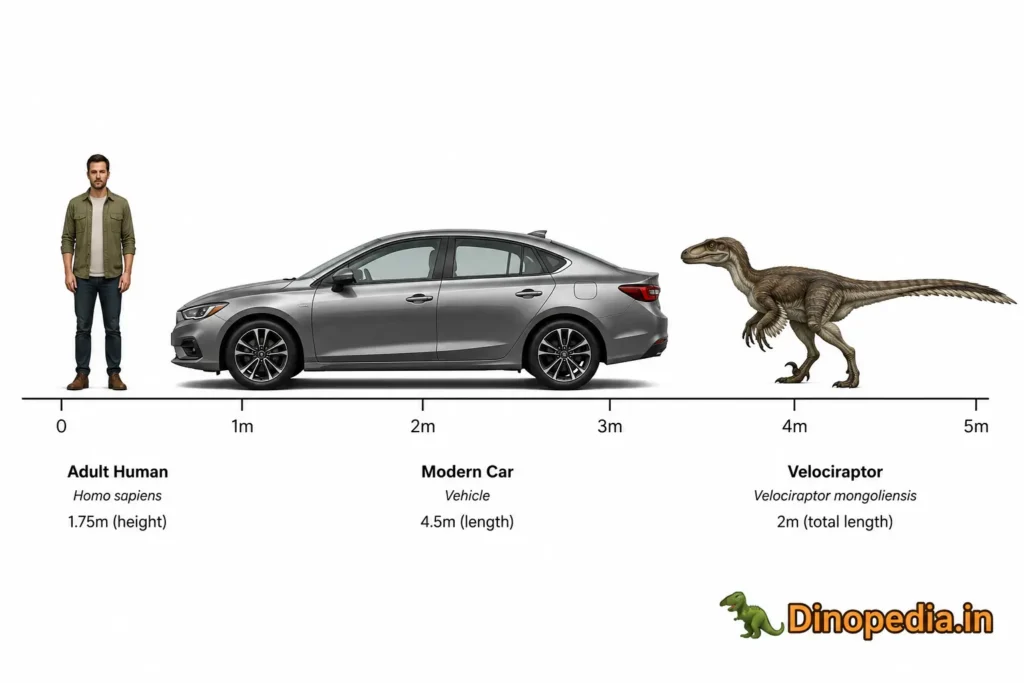
| Length | Around 2 metres — about the length of a motorbike |
| Weight | Roughly 15–30 kg — a medium-sized dog |
| Diet | Meat |
| Speed | Fast enough to be dangerous in a chase, but probably not a sprinter by dinosaur standards — closer to a determined running dog than a cheetah |
Fun Facts
It almost certainly had feathers. Velociraptor fossils show quill knobs on the forearm bones — the same attachment points modern birds use for flight feathers. It couldn’t fly, but it was definitely feathered, probably looking something like an oversized, toothy ground bird.
Its famous claw wasn’t for slashing — it was for gripping. The enlarged sickle-shaped claw on each foot is often imagined raking through prey. Scientists now think it was more likely used to pin struggling animals down, the way hawks and eagles grip prey with their talons today.
It’s closer in size to a turkey than to a human. At around 2 metres long and knee-height to an adult person, Velociraptor was genuinely small. Impressive in the way a large aggressive dog is impressive — not in the way a bear is impressive.
It had a stiff tail; it couldn’t wag. The tail was held rigid by a series of interlocking bony projections, acting as a counterbalance during fast turning. More like a rudder than a tail.
One fossil caught it in the middle of a fight. The “Fighting Dinosaurs” fossil from Mongolia shows a Velociraptor locked in combat with a Protoceratops, the claw embedded in the other animal’s throat. Both died, probably when a dune collapsed on them. The fight was still going when they were buried.
It probably hunted alone, not in packs. There’s no strong fossil evidence of Velociraptor hunting cooperatively. Modern birds of prey — modern birds of prey provide one possible behavioural comparison — are typically solitary hunters. The pack-hunting image is almost entirely a Hollywood invention.
It lived closer in time to us than to T. rex. Velociraptor and T. rex are separated by about 50 million years — roughly the same gap between T. rex and us. The Jurassic Park cast would not have shared a screen in the wild.
Did You Know — Could it outrun you?
Probably — but not by a huge margin. Current estimates suggest Velociraptor could reach speeds of around 25 km/h, though these figures vary depending on the model used, so treat that as a rough middle ground rather than a settled number. The average human sprint tops out around 24–28 km/h, which means a healthy adult might just about keep pace — briefly. The real problem is endurance. Velociraptor was built for sudden bursts and sharp changes of direction. You’d lose the long game.
Myths & Movie Moments
The size. Jurassic Park Velociraptors are based on Deinonychus, a much larger relative. The actual Velociraptor was closer in size to a turkey. The filmmakers knew this and made a conscious decision to scale up for drama. It worked, cinematically. It’s been confusing people ever since.
The smooth skin. Every film, toy, and textbook illustration before about 2007 showed Velociraptor with scaled reptile skin. We now know it had feathers. Updated versions in later Jurassic World films explicitly acknowledge this as an in-universe continuity error, which is either honest or convenient, depending on your view.
The pack hunting. There’s no solid evidence that Velociraptor hunted in coordinated groups. The pack scenes are compelling storytelling, not palaeontology.
The intelligence. Velociraptor had a relatively large brain for its body size — but “smart for a dinosaur” is not the same as “capable of learning from observation and problem-solving its way through a kitchen.” Its behaviour was probably closer to a large bird of prey than to anything mammals would recognise as cunning.
What If It Appeared Today?
A grounded thought experiment — not a prediction.
Velociraptor fossils come from what is now the Gobi Desert in Mongolia and northern China — a dry, rocky, open landscape. If one appeared there today, it would likely find itself in familiar terrain. It would likely have targeted small mammals, lizards, and ground-nesting birds, all of which are present in the region. Modern predators like foxes, eagle owls, and Central Asian wildcats occupy similar ecological niches, and a feathered, 25-kg ambush hunter would probably compete directly with them. Whether it would thrive or struggle is genuinely unclear — the Gobi is harsher now than in the Cretaceous, when the region was more vegetated. The most unexpected consequence might be the local rodent population, which would almost certainly notice.
Could You Keep One as a Pet?
Size problem: It’s manageable — about as big as a border collie. The garden would be fine.
Diet: Raw meat, ideally live prey. You’d essentially be keeping a feathered hawk the size of a dog that expects to hunt.
Temperament: Birds of prey are not domesticated. They are tolerated, under very specific conditions, by people who understand them deeply. Scale that up, add teeth, and remove the centuries of falconry tradition.
Specific problem: The sickle claw. Every time it gripped something — your arm, your furniture, your other pets — it would do so with the instincts of a predatory bird and the force of an animal that evolved to pin struggling prey. Your sofa would not survive week one.
Modern equivalent: A very large, toothy, feathered Harris’s hawk with boundary issues.
Verdict: 🟡 Chaotic — theoretically not impossible, the way an ostrich isn’t impossible, but the outcome would depend entirely on what mood it was in that day.
Curious about the real science? Read the full guide to Velociraptor.
Final Thought
Velociraptor was real — genuinely real, not a movie approximation of real — and the actual animal is stranger and more interesting than the fiction. A feathered predator the size of a dog, hunting across a landscape that would become one of Earth’s great deserts, dying in a sandstorm mid-fight with another animal it couldn’t let go of. That fossil has been sitting in rock for 75 million years. The fight lasted longer than our entire species has existed. That seems worth sitting with.
More Creatures You May Like
Ready for the full scientific deep dive? Read the ExtinctAtlas guide on Velociraptor →