

It Had Eight Feet of Breathing Tube on Its Head
Before air reached its lungs, a Parasaurolophus breathed through nearly eight feet of hollow pipe curling up from its nostrils, over its skull, and back down again. That extraordinary structure — the crest — is one of the most unusual things any large land animal has ever grown. And after a century of debate, we now have a pretty good idea what it was for.
Par-ah-saw-ROL-oh-fus — “par-ah-saw-ROL-uh-fus”
Fast Facts
| Field | Info |
|---|---|
| Time period | Reasonably mobile for its size — built for efficient movement on two legs when needed, though exact speed remains uncertain. |
| Fossils found | Alberta (Canada); New Mexico, Utah (USA) |
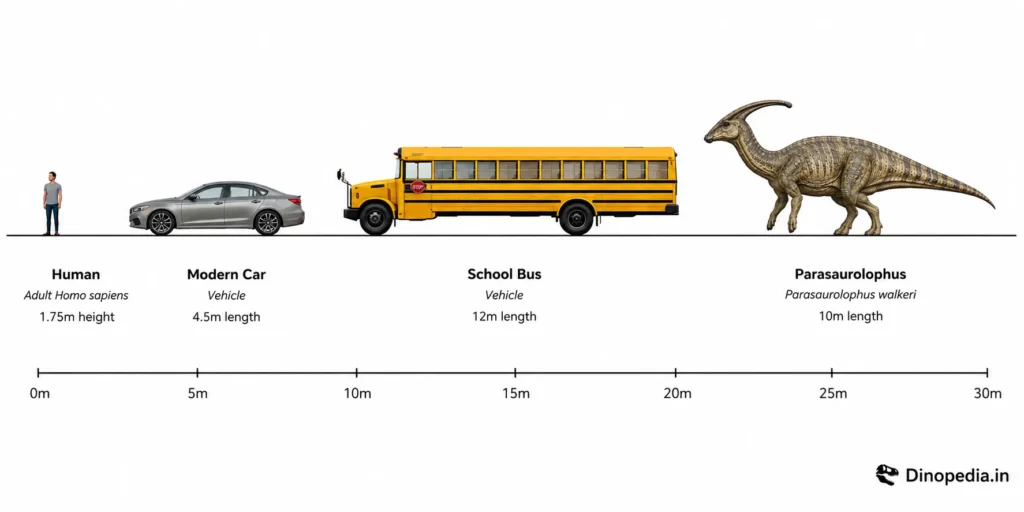
| Length | Around 30–33 feet — roughly the length of a large school bus |
| Weight | 2.5–4 tons — about the same as a large rhinoceros or small elephant |
| Diet | Plants |
| Speed | Reasonably mobile for its size — built for efficient movement on two legs when needed, though exact speed remains uncertain. |
Fun Facts
The crest was probably a musical instrument.
The hollow tubes inside the crest connected the nostrils all the way up, around, and back down to the skull. Computer modelling strongly supports the idea that the crest could have acted as a resonating chamber, producing deep low-frequency sounds. Different crest shapes in different species may have produced different calls.
Babies had tiny crests and much higher voices.
The juvenile fossil nicknamed “Joe” — found in Utah and described in 2013 — shows that young Parasaurolophus had just a small rounded bump where the full crest would eventually grow. Researchers modelled that this smaller structure would likely have produced higher-pitched sounds than adult crests. As the paleontologist who studied Joe put it: if adults had woofers, babies had tweeters.
A new skull wasn’t found for 97 years.
The first Parasaurolophus skull was found in 1922. The next wasn’t discovered until 2017 — in the badlands of New Mexico, nearly a century later. It was exceptionally well-preserved, and it provided one of the clearest looks yet at how the crest bones were constructed and developed.
It could walk on two legs or four.
Parasaurolophus was primarily bipedal — walking and running on its hind legs — but could drop to all fours for slower movement and foraging. This flexibility likely made it effective both at moving quickly when threatened and grazing efficiently when relaxed.
It had roughly 2,000 teeth and constantly replaced them
Hadrosaurs like Parasaurolophus had dental batteries: stacked rows of teeth that ground against one another as new ones grew in from below. At any given time, hundreds of teeth were in active use. It could chew through tough plant material that most animals couldn’t manage.
The crest may have varied between individuals.
Just as no two sets of human fingerprints are alike, the shape and size of Parasaurolophus crests varied between individuals — and possibly between males and females. Whether crest size was sexually dimorphic (larger in males) is still debated, but the variation is real and well-documented.
It was cut from the Jurassic Park stampede scene.
Parasaurolophus was originally slated to appear in the famous Gallimimus stampede in the first Jurassic Park film. The filmmakers switched to Gallimimus because they needed animals that looked faster. Parasaurolophus ended up as background scenery near the Brachiosaurus instead — visible briefly, easy to miss.
Did You Know — Would a Predator Attack One?
Parasaurolophus lived alongside large tyrannosaur relatives, including formidable predators, in Late Cretaceous North America.
A healthy adult would have been a substantial and risky target. At several tons, with herd protection and the ability to move quickly when threatened, Parasaurolophus was not easy prey. Juveniles, isolated animals, or injured individuals would have been far more vulnerable.
It’s reasonable to think warning calls and herd behaviour played an important defensive role.
Myths & Movie Moments
The crest was a snorkel
For decades, one popular theory held that the crest functioned as a snorkel, allowing Parasaurolophus to breathe while submerged. It doesn’t work. The crest has no opening at the tip — air couldn’t enter from the end. This idea has been thoroughly set aside, but it still turns up in older books and some toys.
It was a slow, passive background animal.
In most film appearances — including the Jurassic Park franchise — Parasaurolophus grazes in the background, reacts to danger, and functions as scenery. The real animal was a large, likely social herbivore that may have communicated over long distances using its crest and could move efficiently when threatened. It wasn’t dramatic in the way predators are dramatic. It was successful in an entirely different way.
The crest was a weapon.
Another older theory suggested Parasaurolophus used its crest as a physical weapon — to push through vegetation or in combat. The crest was hollow and relatively fragile. It was not built as a battering tool. It’s most likely roles were acoustic signalling and visual display.
It only lived in one place.
Three distinct species are known: P. walkeri from Alberta, P. tubicen from New Mexico, and P. cyrtocristatus from the American Southwest. Each had a differently shaped crest. Together, they ranged across a substantial stretch of Late Cretaceous North America, separated by geography and time.
What If It Appeared Today?
A Parasaurolophus appearing in the forests and floodplains of Alberta or New Mexico would find a landscape very different from the Late Cretaceous. Whether its digestive system could handle modern vegetation is genuinely uncertain — the plants it evolved to eat no longer exist in the same forms.
If it could adapt, it would very probably be a striking presence. Its deep, resonant calls would likely carry over long distances. If Parasaurolophus lived socially, those calls may have helped individuals stay in contact across open landscapes. Modern predators would almost certainly avoid healthy adults; wolves, mountain lions, and bears would be poorly matched against an animal of this size.
The most unexpected consequence: it’s reasonable to think its vocalisations would dramatically change the soundscape of the region.
Could You Keep One as a Pet?
Size: A school-bus-length animal that can rear up on its hind legs. Your house is not relevant to this conversation.
Diet: Vast quantities of tough plant material processed through hundreds of active grinding teeth, with replacements constantly growing. Your garden would last a weekend.
Temperament: Likely a social animal. Keeping one alone would probably be stressful for it. Keeping several raises the question of where, exactly, you’re planning to put them.
The specific problem: Its crest likely helped it produce loud, resonant calls that could carry over long distances. Your neighbours would have opinions.
Modern equivalent: A very large, socially demanding goose with industrial-scale volume control.
Verdict: 🔴 Absolutely not — and the noise complaints alone would finish you.
Curious about the real science? Read the full guide to Parasaurlophus.
Final Thought
Parasaurolophus built something extraordinary — a resonating chamber grown from bone, capable of producing deep calls across a landscape that no longer exists. Whatever it was saying, it said it loudly enough to matter. The fact that we can now model what those sounds may have been like, from fossils found a century apart, is its own kind of wonder.
More Creatures You May Like


Ready for the full scientific deep dive? Read the ExtinctAtlas guide on Parasaurolophus →